What is data annotation? A complete guide for beginners


AI is becoming part of everyday life, from apps to smart assistants, and it relies on large amounts of data to work properly. This creates new opportunities for people to make money online without special skills through specific AI training tasks.
You’ve probably helped train AI without even realizing it, and in this guide, you’ll learn exactly how that happens.
What is data annotation?
Data annotation is the process of labeling data like text, images, or audio so it can be used for AI training.
In simple terms, you’re giving a computer labeled examples, such as tagging objects in images or labeling words in text, so it can learn patterns and recognize similar things on its own, similar to what a CAPTCHA solver is trying to interpret human input.
Think of it like teaching a kid using flashcards. You point to a picture and say, “this is a dog,” and after enough examples, they start recognizing dogs by themselves.
AI models rely on the same logic, and thanks to task-earning apps, you can actually get paid to handle these simple labeling jobs yourself.
Label data, make money online
From images to text, turn beginner-friendly annotation tasks into quick online earnings with JumpTask.
Why annotated data is essential for artificial intelligence
AI uses advanced machine learning algorithms, which makes it seem smart — but it cannot figure things out on its own from the start. It needs clear, labeled examples to learn from. Without that, it would just see random data with no meaning.
Example: Voice assistants
The same idea applies to voice assistants like Siri. When you speak to them, they need to:
- Turn your voice into text (words)
- Understand what those words actually mean
They cannot guess this on their own — they have to be trained first.
People help by:
- Recording short audio clips
- Labeling them by writing down exactly what was said (e.g., “set an alarm for 7 AM”)
- Adding extra labels about intent, such as whether the person is setting an alarm or asking a question
After seeing thousands or even millions of these labeled examples, the AI starts to recognize patterns and learns to understand your voice when you speak.
So, while AI models may seem automatic, they actually depend heavily on human input. Data annotation plays a crucial role in teaching these systems how to see, hear, and understand the world.
How the data annotation process works in real life
In real life, data annotation is much simpler than it sounds.
Here is what it usually looks like for you:
- You log into a platform and receive data annotation tasks.
- The tasks show you something like an image, a sentence, or a short audio clip.
- You follow the simple instructions provided on the screen.
- You complete the task by clicking, highlighting, or choosing the correct label like “positive” or “negative.”
- You submit your work and move on to the next task.
Think of it like sorting photos or organizing files on your computer. You are just looking at something and putting it in the right category. The online annotation tools are already set up for you, so most of the time, you are just clicking, dragging, or typing simple answers.
This is not technical work in the way people usually think. You are not writing code or building AI systems. You are helping train them by doing small, simple tasks that anyone can learn quickly.
Pro tip: Platforms often include quality control steps to review your work and ensure the labels are accurate before the data is used. So, take a moment to carefully check your labels so you can avoid mistakes and improve your results.
What are the different types of data annotation services?
With the basics covered, let’s move on to the main types of data annotation and their uses.
Text annotation in natural language processing tasks
Text annotation involves working with written content and helping AI understand what the text actually means.
You read things like emails, chatbot messages, social media posts, or product reviews and then label them based on their meaning. This includes sentiment analysis, which means identifying the emotional tone of the text, such as whether it is positive, negative, or neutral.
You might mark a review as “positive” or “negative,” or label a message as a complaint, a question, or a request.
Sometimes you also highlight specific parts of a sentence, like the exact words that show a feeling such as frustration or happiness.
It would look something like this:
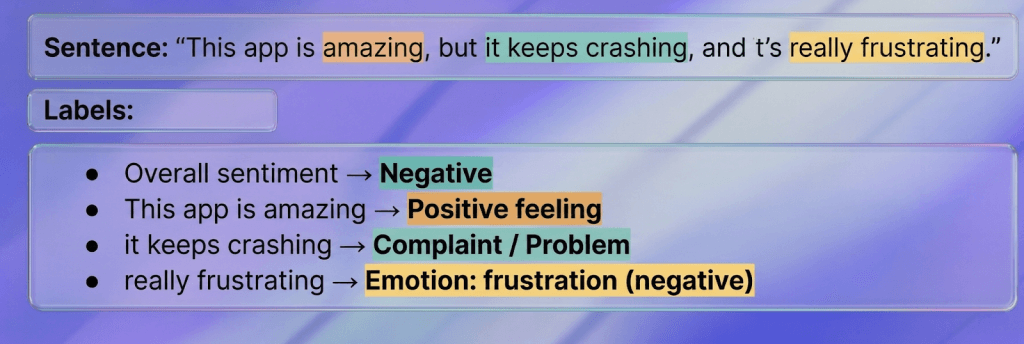
By giving accurate annotations over and over, you are teaching the machine learning algorithms how to understand tone, meaning, and intent in everyday human language.
This is what allows tools like chatbots to respond properly, email filters to sort spam, and apps to understand how people feel based on what they write.
In practice, you would use data annotation tools or text annotation tools such as Labelbox or Amazon SageMaker Ground Truth, where everything is set up for you, and you just select text and assign labels with a few clicks.
Image annotation using bounding boxes
Image annotation is the process of identifying objects in an image so AI can understand both what is in the picture and where each object is located.
A common method is box annotation, which means drawing bounding boxes around the objects you are asked to identify.
For example, you might:
- Draw a box around a car and label it “car.”
- Draw another around a stop sign and label it “stop sign.”
- Mark a person and label them “person.”
After being trained on thousands of labeled images, AI can start recognizing and locating these objects on its own. This labeled content becomes the training data used to teach the model.
This type of annotation is especially important in self-driving cars, where the system needs to detect:
- other cars
- pedestrians
- traffic signs
- the position of those objects on the road
Some projects require more detailed labeling through semantic segmentation, also called semantic annotation. Instead of drawing simple boxes, this method labels each part of the image pixel by pixel.
That gives the AI a more precise understanding of the full scene, including elements like the road, sky, cars, and people.
For these tasks, you would use image annotation tools like CVAT or LabelImg. They make this process simple by letting you draw boxes and label them directly with your mouse.
Audio annotation for voice and sound labeling
Audio data annotation is listening to recordings and helping the AI applications understand what is being said and how it is being said. So, if someone says “open the app,” you write that down so the AI learns to connect the sound with the correct words.
You can also add labels about how something is said. You might mark that the speaker sounds happy, angry, or calm, or note if it is a man or a woman speaking.
This is how tools like voice assistants learn to recognize speech and respond correctly when you talk to them.
To do this work, you can use tools like Audacity or Rev AI to listen to recordings, review them, and label audio clips in a clear and organized way.
Video annotation in computer vision tasks
Video annotation is when you watch video frames and help AI understand what is happening by labeling objects, actions, and changes as they happen.
Instead of just looking at one image, you are watching a sequence of frames. You could follow a person walking across a street by drawing a box around them and keeping that box on them as they move. You might also label actions like “walking,” “running,” or “falling.”
This is used in self-driving cars, security systems, and sports analysis, where AI needs to understand movement and behavior, not just what is there in still images.
And if this feels like a lot, that is completely normal. There are different types of annotation, but data annotation platforms usually guide you step by step. They show you exactly what to do, so you are never figuring it out on your own.
To help with this process, video annotation tools like CVAT are commonly used, giving you features to mark and track objects frame by frame.
How you can earn money by labeling data
JumpTask is an online earning platform built for anyone who wants to earn with specific tasks. Watch videos, train AI, complete micro-tasks, or simply engage with brands online and get paid.
Using these apps, you can do image segmentations, tag text, or listen to short audio clips for money. If you can click, read, or drag a mouse, you can do this.
If you are looking for an easy way to make money online, data labeling can be a good starting point. It is entry-level, flexible, and remote, which means you can earn from home and fit it around your own schedule.
You will not get rich from it, but it can be a way to earn extra money in your spare time.
Below is a real comment from someone working in data annotation, sharing their honest experience about workload, pay, and what to expect from this type of work:

[Source: Reddit]
Teach AI, get paid, repeat
Label, tag, and train AI in minutes while stacking up rewards on JumpTask.
Key takeaways
- Data annotation is labeling data types such as text, images, audio, or video so AI can learn from it and understand the world better.
- AI depends on people to train it because it cannot learn without clear examples that are labeled and explained.
- The work is simple and manual, involving tasks like clicking, highlighting, and tagging, with no coding required.
- It is a flexible way to earn extra money online, and beginners can start with basic skills like reading and following instructions.
FAQs
Just think of it as work that helps turn raw data into something AI can understand. This includes teaching machines what things mean, so they can recognize patterns, make predictions, and respond correctly to new information.
Yes, human annotators can earn money, but not enough to reach a full-time salary. Earnings depend on the platform, task type, and how much work you complete.
You need basic reading skills, attention to detail, and the ability to follow instructions. No technical or coding skills are required.
Not exactly. Data annotation is part of AI training. It is the process of labeling data, while AI training uses that labeled data to actually teach the model how to learn and improve.

Gabriele Zundaite
Digital Marketing Manager
Meet Gabriele, a marketing specialist focused on digital growth and social media. As a Digital Marketing Manager at JumpTask, she helps others discover new ways to earn online by turning creative ideas into real results. With a degree in Marketing Management and a background in growth marketing and community building, Gabriele shares clear, practical advice for anyone ready to start earning or grow their online presence.
Share:


IN THIS ARTICLE
- What is data annotation?
- Why annotated data is essential for artificial intelligence
- How the data annotation process works in real life
- What are the different types of data annotation services?
- How you can earn money by labeling data
- Key takeaways
- FAQs
Related Articles